


Overview
While inspecting compiled binaries or troubleshooting stack traces on Linux, developers routinely stumble across cryptic, gibberish-like symbol names. These bizarre identifiers stem from name mangling—an automated mechanism through which C++ compilers encode namespace boundaries and overloaded parameter types into distinct linker symbols. This guide explores the inner mechanics of c++filt, showing how engineers can seamlessly translate these obfuscated identifiers back into clean, human-readable function declarations.
Installing Binutils and Demangling Basic Symbols
To provision the system with the GNU binary utilities containing c++filt, execute apt-get update -qq && apt-get install -y binutils.
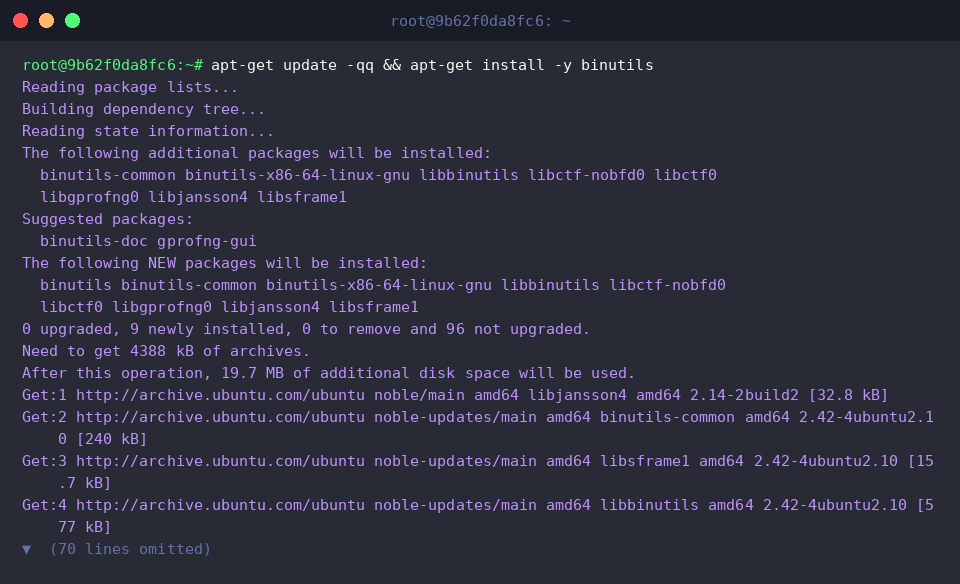
Run c++filt --version | head -n 2 to verify the installed utility release and environment readiness.
At its core, c++filt acts as an automated demangler, restoring compiler-encoded identifiers to their native class, namespace, and function signatures.
⚙️ [Core Command-Line Options]
-_, --strip-underscore : Strips leading underscores from target symbols prior to demangling.-n, --no-strip-underscore : Retains initial underscores, preventing automatic symbol trimming.-p, --no-params : Omits function parameter signatures, displaying solely the bare identifier name.-t, --types : Demangles standalone type descriptors alongside regular function identifiers.-s, --format : Explicitly selects a demangling schema corresponding to particular compiler ABI specifications.

To decipher an elementary mangled symbol, run c++filt _Z1fv.
The utility translates the encoded token into f(), accurately reconstructing a zero-argument function signature.

Pass a richer symbol containing namespace encapsulation and typed argument definitions by executing c++filt _ZN4Math3addEii.
The tool breaks down the symbol hierarchy to reveal the member function add nested inside namespace Math, taking two int parameters: Math::add(int, int).

Inspecting Mangled Binaries via nm and the Compilation Pipeline
Set up a functional C++ compilation toolchain by executing apt-get update -qq && apt-get install -y build-essential.

Generate a test harness featuring overloaded methods wrapped inside a distinct namespace by executing cat << 'EOF' > /tmp/demo.cpp.
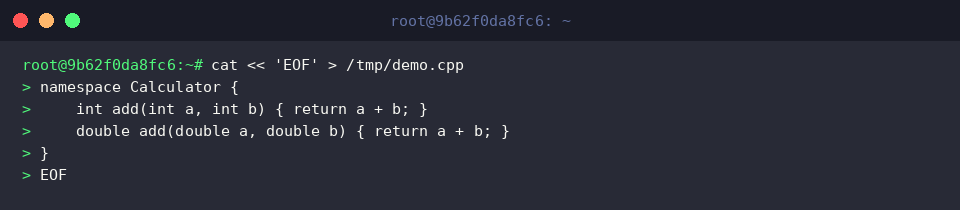
Compile the sample code into a binary object file populated with machine symbols using g++ -c /tmp/demo.cpp -o /tmp/demo.o.

Inspect the exported symbol table for references to the add routine by issuing nm /tmp/demo.o | grep add.
Because the compiler must differentiate overloaded variants at the linker level, the identifiers appear transformed into the mangled forms _ZN10Calculator3addEii and _ZN10Calculator3addEdd.

Pipe the raw nm output directly through the demangler by executing nm /tmp/demo.o | c++filt | grep add.
Passing stream data through c++filt immediately unscrambles these obscure tokens, exposing the intuitive function signatures Calculator::add(int, int) and Calculator::add(double, double).

Resolving Complex Template Instantiations in Real Time
Create a source file demonstrating heavily nested template structures using standard containers by running cat << 'EOF' > /tmp/template_demo.cpp.
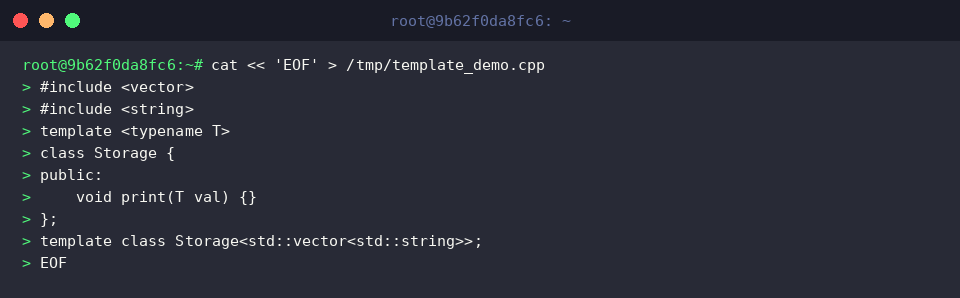
Build this template specification into an unlinked relocatable object with g++ -c /tmp/template_demo.cpp -o /tmp/template_demo.o.

Query the object file for symbols tied to the print member method by running nm /tmp/template_demo.o | grep print.
Due to the deep hierarchy of instantiated STL types, the compiler generates a sprawling, virtually unreadable string of mangled characters.

Feed the symbol listing into c++filt dynamically by invoking nm /tmp/template_demo.o | c++filt | grep print.
The pipeline resolves the labyrinthine token on the fly, reconstructing the full template signature along with its specialized container parameters in a clear, readable format.

Stripping Parameter Signatures and Parsing Application Logs
Retrieve the comprehensive signature for an encoded method by executing c++filt _ZN10Calculator3addEii.
Default demangling behavior preserves the full structural signature, rendering the qualifying scope, function name, and typed parameter list (int, int).

Strip away parameter definitions for a concise identifier view by executing c++filt -p _ZN10Calculator3addEii.
Leveraging the -p flag drops the argument parentheses and inner types, leaving only the scoped identifier Calculator::add.

Test the type-decoding mode against the symbol using c++filt -t _ZN10Calculator3addEii.
Supplying the -t argument keeps the underlying function hierarchy and argument types intact, faithfully returning Calculator::add(int, int).

Stream diagnostic error strings directly into the demangler by running echo 'Fatal error in _ZN10Calculator3addEii at runtime' | c++filt.c++filt processes arbitrary text streams non-destructively: it preserves surrounding context words while pinpointing and translating any embedded C++ symbols inline.

Understanding C++ name mangling clarifies why compiled symbols look like random gibberish and how tools like c++filt bridge the gap between machine-level object tables and source code.
Whenever linker errors, missing vtable references, or core dumps surface during development, integrating c++filt into your diagnostics will rapidly bring clarity to your debugging workflow.